| Journal of the POMA - Vol 70, No 1 - February 2026 |
From the Editorial Board
Thawing Hearts, Emerging Springs
By Porsche Lee, LECOM OMS-III
As winter loosens its icy hold and February’s final days whisper toward spring, we enter a quiet season of change. The early months often bring long clinical days, full schedules, and, for many students and residents, the anticipation of Match and the uncertainty of what lies ahead. These months can feel heavy, yet they invite reflection — a reminder that growth often occurs quietly, beneath the surface, even when unseen.
February marks American Heart Month, a moment not only to raise awareness about cardiovascular health but also to honor the heart as a symbol of warmth, empathy, and human connection. For osteopathic physicians, it is a reminder that our work extends beyond organs and diagnoses. We care for whole people, guided by presence, understanding, and the belief in the body’s capacity to heal. The heart is more than an organ; it reflects why many of us chose medicine, serving as a symbol of the attentiveness, compassion, and care that define our work.
Each day, we are entrusted with moments of vulnerability, and that trust calls not only for skill but for humanity.
The season’s frosty storms can still test our endurance. Patient volumes rise, illnesses surge, and the weight of caring for others can feel heavy. Students and residents face the added pressures of exams, evaluations, and career transitions. In such moments, it is easy to focus solely on tasks and outcomes. Even amid these demands, however, we are invited to pause, reflect, and reconnect with the deeper purpose of our work. Resilience in medicine is not merely endurance. It is nurtured through mentorship, collaboration, and the quiet gratitude of patients. It grows when we support one another, extend grace to ourselves, and recognize that periods of intensity often lay the foundation for renewal and new opportunities.
As spring approaches, bringing new rotations, roles, and milestones, we are reminded that change is inherent to our profession, just as flowers begin to sprout and grow, quietly reaching toward the light. Careers evolve, responsibilities shift, and communities expand, yet what endures is the heart of osteopathic medicine: a commitment to holistic care, prevention, and compassionate service. This February, as we reflect on both literal and symbolic hearts, may we carry warmth, hope, and purpose forward.
|
Rudolph Revealed: An In-Person Interview
By Samuel Garloff, DO, PCOM '78
WGRP reporting from the North Pole. Shortly after the Christmas holiday, I arranged an interview with Rudolph, the famous red-nosed reindeer. What follows is a transcript of our conversation.
Rudolph, thank you for agreeing to this interview.
“Let me guess, you want to know about my nose. Well, pal, you’ll have to hear the whole story, start to finish…
I was born on November 16, 1947, and my birth was anything but natural. You see, Montgomery-Ward in Chicago gave out booklets every year to children for free at Christmas time. One year, they asked Robert L. May, an advertising copywriter, to write a Christmas story for the children so they wouldn’t have to buy a story elsewhere and cut into their profits. May wrote “Rudolph the Red-Nosed Reindeer,” and I magically came to life. Montgomery-Ward gave away millions of the booklets over the years. One year, Robert summoned his courage and asked for sole ownership of the story. As a result, he became a millionaire collecting profits on books, records, lunch boxes, toys, clothing, TV shows, etc. Montgomery-Ward actually sold the merchandise that May grew rich on. I got nothing. Oh, the irony!
|
Barriers to Achieving Health Literacy
By Angela Zawisza, DO, DMUCOM '07
“I don’t know how my parents would have managed this if I wasn’t a physician.”
This statement came from a colleague of mine, as we were discussing her father’s recent heart attack and my own father’s traumatic hemopneumothorax and subsequent hospitalizations. I echoed her sentiments, and my mind started down the rabbit hole of health care literacy in the United States.
The definition of health care literacy changed with the release of the US Government’s Healthy People 2030 initiative, compared to the Healthy People 2010 and 2020 definition. According to the newest initiative, health care literacy is defined as the following:
- “Personal health literacy is the degree to which individuals have the ability to find, understand, and use information and services to inform health-related decisions and actions for themselves and others.
- Organizational health literacy is the degree to which organizations equitably enable individuals to find, understand, and use information and services to inform health-related decisions and actions for themselves and others.”
The changes in the definition, according to the CDC, “emphasize people's ability to use health information rather than just understand it, focus on the ability to make ‘well-informed’ decisions rather than ‘appropriate’ ones, acknowledge that organizations have a responsibility to address health literacy, and incorporate a public health perspective.”
|
Strengthening Osteopathic Clinical Skills in Pennsylvania: The C3DO Project’s Collaborative Approach in Osteopathic Medicine
By Jeanne M. Sandella, DO, PCOM '99
Vice President for Professional Development Initiatives & Communications, NBOME
Osteopathic medicine emphasizes a patient-centered approach that integrates the body’s structure and function in both diagnosis and treatment. At the heart of ensuring the osteopathic profession trains physicians dedicated to person-centered care in an increasingly technical world of healthcare is the Core Competency Capstone for DOs (C3DO) project—a groundbreaking initiative that brings together the National Board of Osteopathic Medical Examiners (NBOME) and leading colleges of osteopathic medicine (COMs).
The C3DO project was conceptualized in response to the rapidly evolving landscape of healthcare education and practice, and patient needs. The COVID -19 pandemic resulted in a discontinuation of many national assessments for clinical skills as part of physician licensure. In response, the NBOME launched the Special Commission on Osteopathic Medical Licensure Assessment, which convened from 2021-2023 to evolve osteopathic clinical skills assessment into a national, standardized assessment that could be delivered at COMs.1
The resulting C3DO program, now in its fourth year of pilot testing, has grown to over 17 locations nationwide and will be integrated into the COMLEX-USA program starting in 2028 as an option to fulfill the requirement of clinical skills verification.
|
What a Waste
By Joseph Zawisza, DO, PCOM '05
Whether we like it or not, Medicine is a business, no doubt about it. A quick Google search indicates that the US healthcare market was valued at $4.87 trillion in 2025 and will increase to $5.15 trillion this year. Furthermore, in 2020, healthcare spending accounted for 19.7% of the U.S. economy, and currently, the healthcare sector employs over 20 million people in the United States.
As a solo practitioner, I realize that my primary care private practice makes up the most minuscule slice of the healthcare pie. What makes up a much larger slice of the pie is wasteful spending. One of the not-so-well-kept secrets in Medicine, the amount of wasteful spending is enough to give you chest pain, which will be followed by an EKG, cardiac enzymes, a stress test, a nuclear stress echo, electrolytes, a urine drug screen, an upper GI series, PFTs, a CT scan, and probably a colonoscopy, “just to be safe” of course. A 2019 study published in JAMA (Waste in the US Health Care System: Estimated Costs and Potential for Savings, William H. Shrank et al.), which reviewed studies in healthcare waste published between January 2012 and May 2019, determined that the annual wasteful spending in healthcare ranged from $760 billion to $935 billion. The potential savings from interventions that address waste were $191 billion to $286 billion. I think it is safe to say those numbers will be much higher in 2026.
|
Health Behavior Change and Treatment Adherence: Evidence-based Guidelines for Improving Healthcare, 2nd Edition, by M. Robin DiMatteo, Leslie R. Martin, and Kelly B. Haskard-Zolnierek
By Samuel Garloff, DO, PCOM '78
This second edition publication lives up to its title: It is evidence-based. Although deceptively easy to read, it is for the serious and interested practitioner wanting to know how to best interact with patients to optimize treatment adherence and outcomes. Students of the Health Belief Model (HBM), dating back to the 1950s, will be quite pleased with this book.
Written by three university professors, the book is well-suited for self-study, discussion groups (such as a resident class), and classroom learning. Each of its nine chapters ends with “Tools for Self-study and Instruction,” learning objectives, review questions, prompts for discussion and further studying, and suggested reading. Additionally, each chapter ends with a comprehensive listing of references—a bibliophile’s dream.
|
The One Where the Classroom Becomes the Clinic
By Stephie Thomas, LECOM OMS-III
The first two years of medical school went by quickly, long days in the lecture hall, even longer nights studying, and an endless cycle of exams with barely enough time to breathe. Stepping into third year felt both exciting and intimidating. It meant returning to the clinical wards and caring for real patients again. Suddenly, it wasn’t enough to simply recall information. I had to apply it to complex situations, to real people with real consequences. Seeing physiology, anatomy, and microbiology come together at the bedside has been eye-opening and has finally put into perspective everything I learned during the preclinical years.
As I’ve moved through my rotations, I’ve kept returning to something Mark Reid once said: “Student, you do not study to pass the test. You study to prepare for the day when you are the only thing between a patient and the grave.” It’s a stark reminder that medicine is far more than memorization. It requires clinical judgment, communication, teamwork, humility, and resilience. At a time when medicine is often scrutinized and misinformation spreads easily, it feels more important than ever to stay grounded in why I chose this path in the first place: to care for patients. That purpose has become my anchor.
|
seasonal 333
By Richard Donze, DO, MPH, PCOM '78
modern medico babble
would call it “shared
decision making” I call
it being ordered around
the chief complaint was
an eye roller cold with
lingering cough how
long lingering? weeks
at least as I plan to pull
|
Raindrop
By Maya Rakoczy, PCOM OMS-II
What’s in a drop of rain?
The morning’s hopeful dew,
A peaceful Sunday drive,
A turf field misted through.
Storm clouds prophesy its falling,
Heavy and obscure,
Charged by lightning’s crackle,
A burden gone; a cure
When winds turn warm in springtime,
The raindrop quenches thirst,
But in the chill of wintertime,
It stifles what was nursed
|
Code Status
By Maria Sara Cueto, LECOM Seton Hill OMS-III
Another stranger in my room
-how long have I been lying on this hospital bed for? -
He asks me about my wishes when Death approaches
-as if he knew better than I do that He’s my shadow.
Do I want the pain to be gone?
|
What Made Me Fall in Love with Osteopathic Medicine
By Ted Eisenberg, DO, PCOM '76
My introduction to osteopathic medicine was deeply personal. I grew up watching my two older brothers, both osteopathic general practitioners (Ron PCOM ’64 and Barry PCOM ’71), care for their patients with skill, compassion, and authenticity. While I was still an undergraduate, I witnessed firsthand the profound difference they made...
|
Restoration as Motivation
By Swagato Kanjilal, LECOM OMS-III
As a first-generation future physician, I did not get a true understanding of osteopathy until medical school. However, the techniques we learned have been the most practical things I have learned thus far. Recently, I was able to help my mom with the chronic knee pain she has had for years. By readjusting her hips with muscle energy...
|
Being a Doctor
By Barry Getzoff, DO, PCOM '60
Once we have completed our certifications and additional training, we open a practice—either by joining one or starting our own solo practice. What happens after that is subject to how you interpret being a doctor. No one tells you what to do or how to approach a patient or what to say in the examining room. I found a few things that have been helpful and have led to a successful practice. One of them is to be a good listener and absorb as much as you...
|
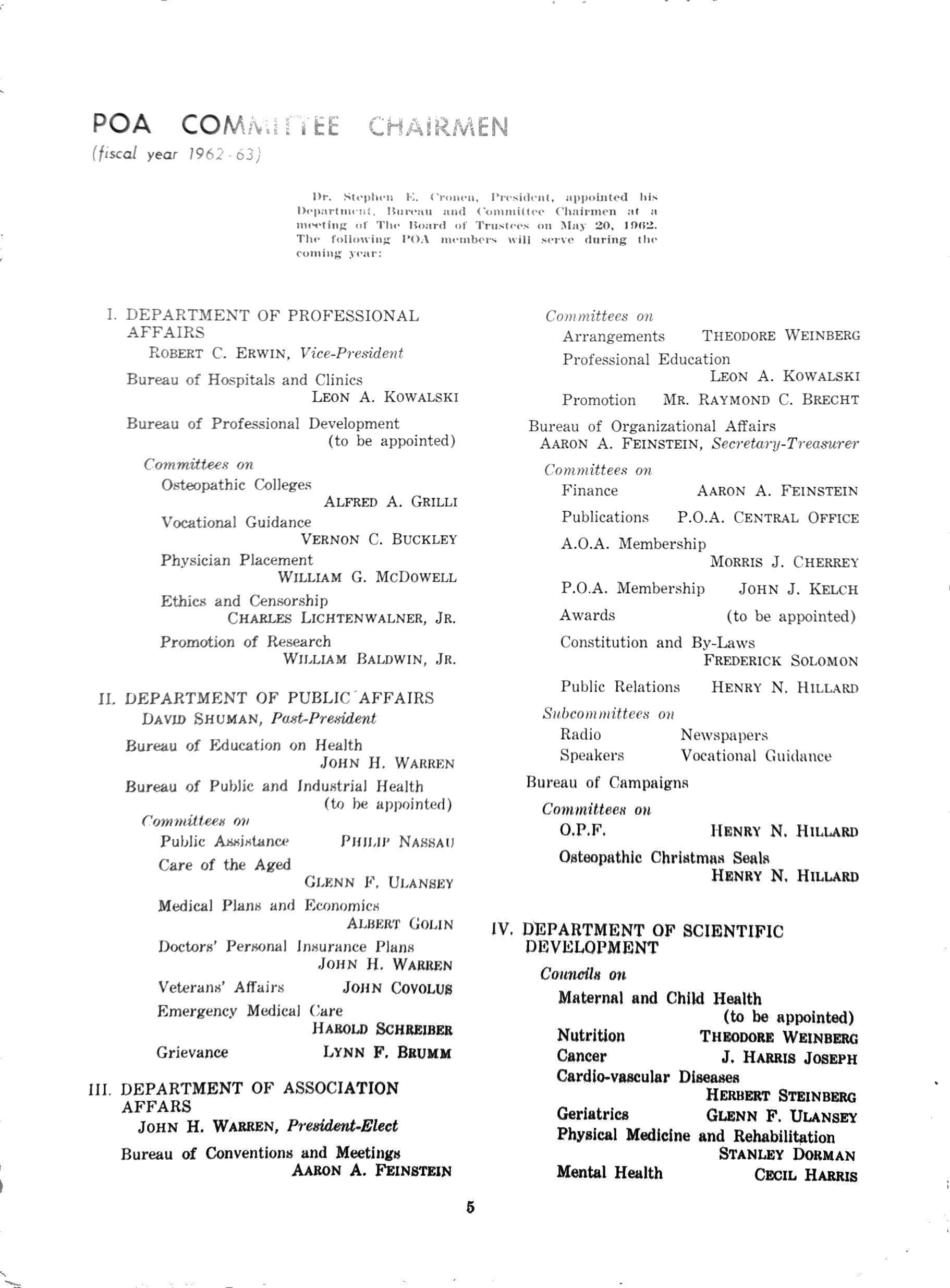
Committees have always been a vital part of the Pennsylvania Osteopathic Medical Association. Just look at this page from the summer edition of the JPOA in 1962, outlining the committee chairs for the next fiscal year. While the actual committees are a bit different, the goals of the organization appear to be the same in 1962 as they are now in 2026, with a focus on support for osteopathic physicians and their patients. POMA firmly believes that change should start with our members. If you are interested in being part of the newest POMA initiatives, please click here to fill out our Call for Volunteers and let us know which committee you would like to join.
|
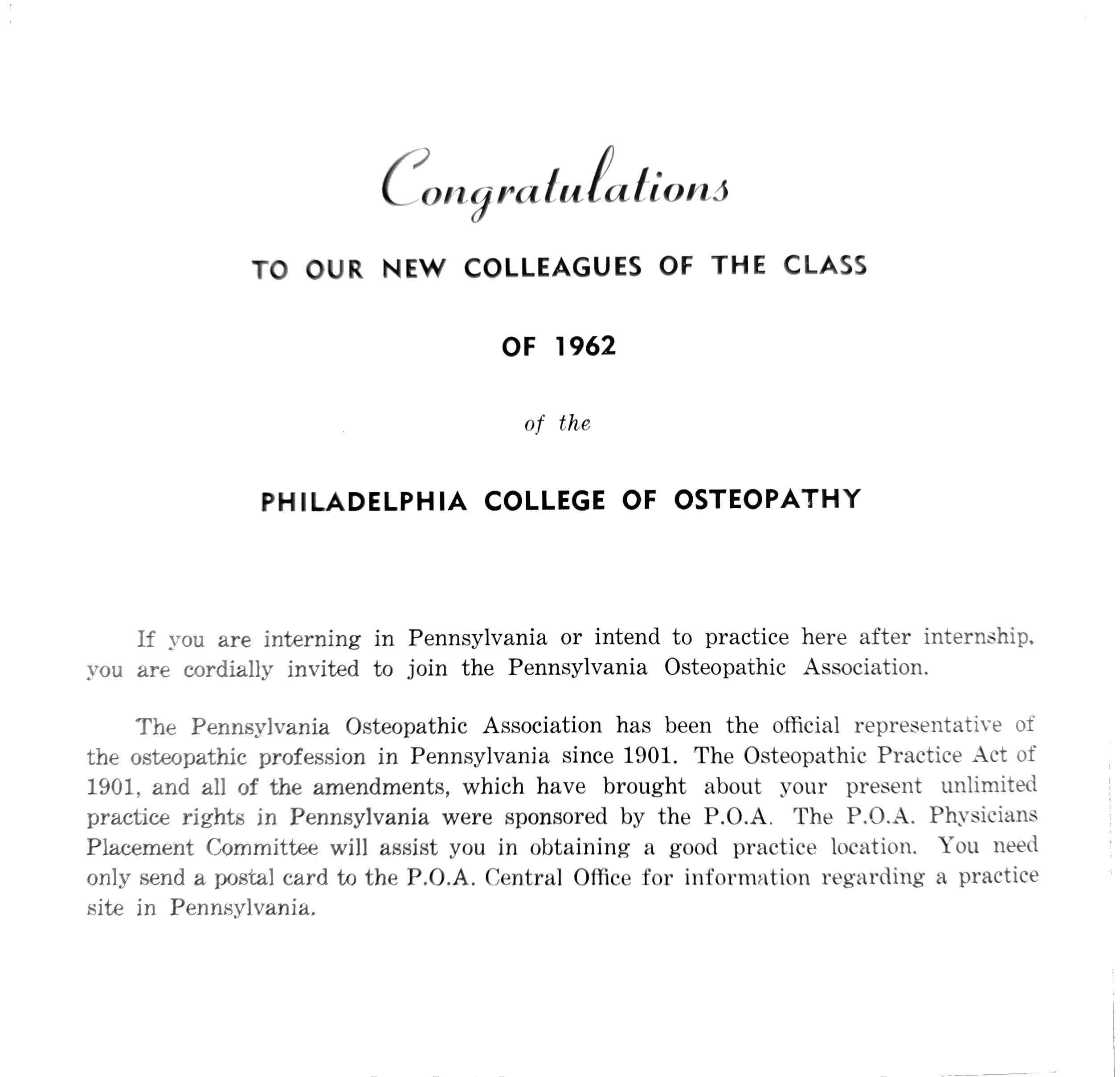
Even in 1962, membership was a key discussion at the Pennsylvania Osteopathic Association, as POMA was known then. This ad congratulates the recent graduates of the Philadelphia College of Osteopathy and invites them to join the POA. Now in 2026, we are still focusing on membership in an era where many organizations are suffering the same fate.
|
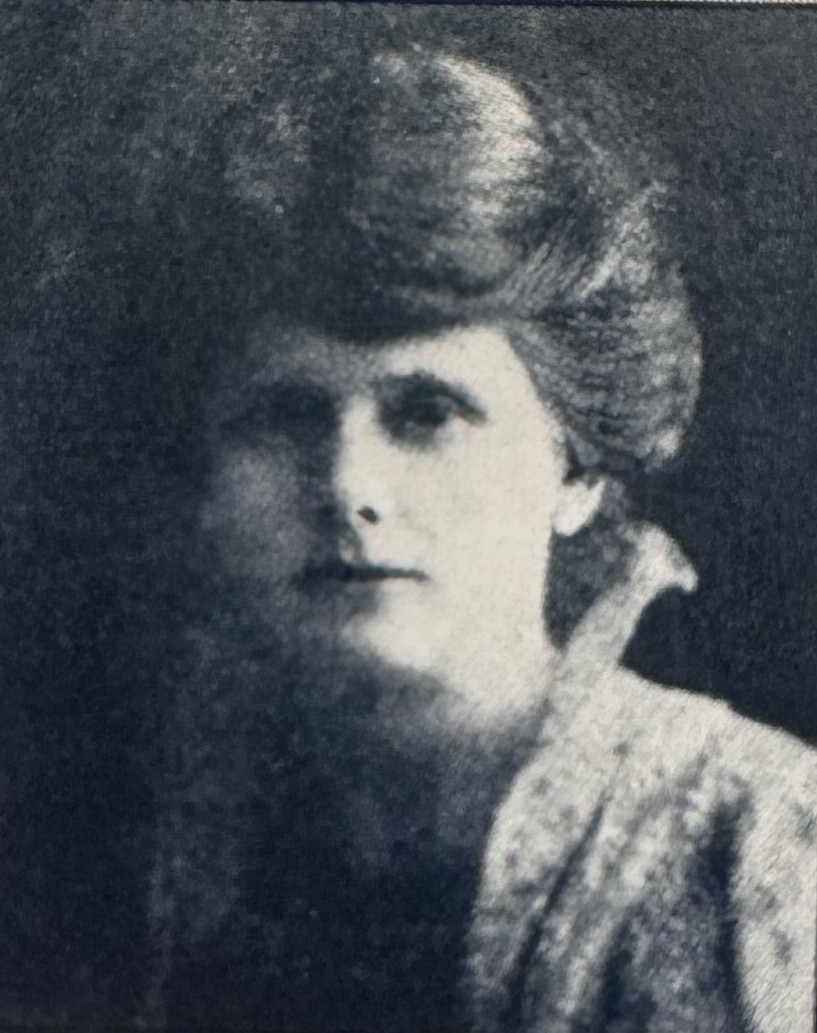
Given that National Women Physicians Day was February 3, it is fitting that this month’s Guess Who is the first woman president of the Pennsylvania Osteopathic Medical Association. She served as president from 1919–1920, but it was another 80 years before the second woman president was installed.
Click here if you can identify this pioneering osteopathic physician!
The answer will be revealed in JPOMA's June 2026 issue.
(Answer to JPOMA's October 2025 Guess Who? - Galen Young, DO)
|
Members of our osteopathic community are the best and brightest. We honor the passing of these POMA members. We recognize their contributions and legacies to the profession and to POMA. To friends and families, we offer sympathies.
|
Publication Notes
Disclaimer
Views expressed in The Journal of the Pennsylvania Osteopathic Medical Association are solely those of the authors and do not necessarily reflect the opinions of the editorial board, The JPOMA, or POMA unless specified.
Letters to the Editor
We welcome your thoughts and feedback. Letters to the Editor may be submitted to [email protected].
About the JPOMA
Frequency
The Journal of the Pennsylvania Osteopathic Medical Association will be published three times a year: February, June, October.
Submission Information
The Journal of the Pennsylvania Osteopathic Medical Association is a safe space for all DOs to have a voice and be heard. Opportunities to contribute in all content areas are open to all osteopathic medical students, residents, and physicians. Share your thoughts, ideas, and submissions via email to [email protected].
Submission Deadlines
The Publications Committee will review submissions one month prior to publication. The rolling submission deadlines are as follows:
- January 15th for the February issue
- May 15th for the June issue
- September 15th for the October issue
Editorial Board
The POMA Publications Committee serves as the editorial board for the Journal of the Pennsylvania Osteopathic Medical Association. The committee is chaired by Joseph Zawisza, DO, and includes Richard Donze, DO; Katherine Galluzzi, DO; Samuel Garloff, DO; Porsche Lee, LECOM OMS-III; and Zachary Mendola, LECOM OMS-II. POMA President-Elect Angela Zawisza, DO, serves as champion of POMA's Communications Pillar.
|
|
|